
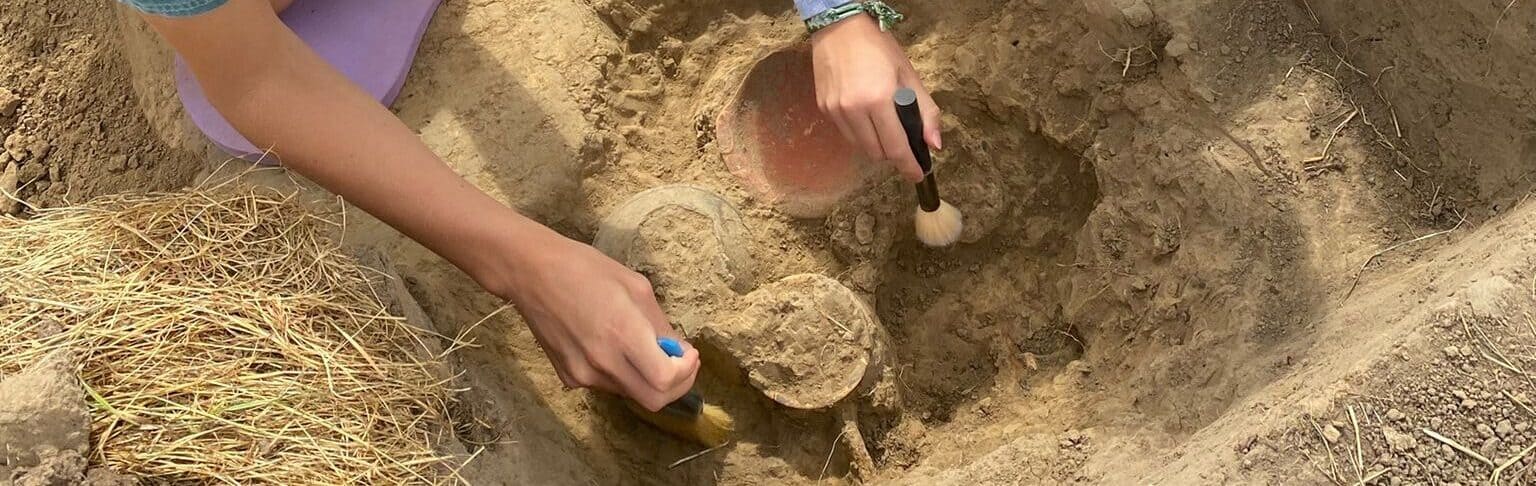
Supra Lemanem 1 (2022) – a high status burial in a civilian settlement
Following extensive geophysical surveying, a successful two-week community excavation took place on a site near Shepway Cross, named ‘Supra Lemanem’ (a hilltop occupation site above the Roman fort of Portus Lemanis) by lead archaeologist Richard Taylor. The dig not only confirmed that it is a Romano-British site, but has thrown up other possibilities and questions regarding its function and date.
Three evaluation trenches were sited over geophysical anomalies. Trench 1 was sited over a strong, rectangular magnetic anomaly, which duly turned up a wall, two in-situ floor tiles, a post hole, numerous Romano-British pottery sherds, a few coins and a significant amount of lead and iron slag. The current thinking is that it represents a small industrial/workshop site.
Trench 2 was sited over an area inside what appeared to be an enclosure. This was an area some distance away from the likely concentrated industrial and occupation areas to the south; it was thought this could be for burials and so it turned out.
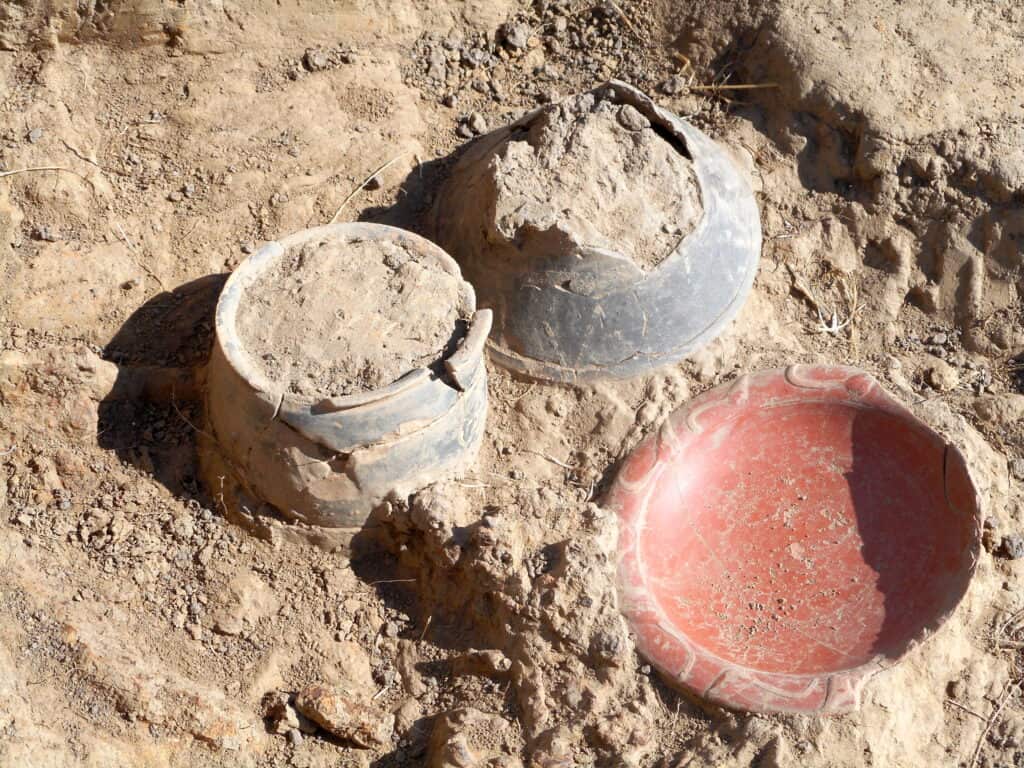
The three vessel cremation burial
On clearing the topsoil, the machine bucket clipped the top of a Samian dish (AD 145- 185), revealing a three-vessel cremation burial, including in-situ hobnails from a pair of boots/shoes. It is most likely the burial of someone senior in the Roman military. The cremation burial wasn’t removed but carefully recorded and back-filled.
Trench 3 produced many Romano-British finds from varied contexts, including around 60 coins, the majority early fourth century, a variety of box flue tile fragments with different patterns and a small linear ditch containing three coins (again, early fourth century) and a quantity of animal bone.
The current thinking is that 2022’s excavation area is possibly a vicus (civilian settlement) serving a fortification situated in a field further south, both likely to date from the second century and used until well into the fourth century.
SHAL’s excavation proved successful regarding the archaeological results and community engagement, with many local residents and other local groups involved in the two-week project.