
Experimental Archaeology
Experimental archaeology can be an engaging way to understand how earlier people left the remains we now find, using the knowledge and technology of their time.
Founder members of SHAL decided that it would be an informative and useful project to build a plinth to replicate the walls of Stutfall Castle using the same materials and methods as the Romans would have used. The plinth would then be used for commemorative and informational purposes.
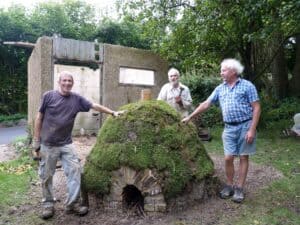
The first part of this project was to produce a substantial quantity of lime mortar. Two members kindly offered their land as the site, which fortunately also contained the limestone rock, timber, clay and turf required. The team smashed the rock into tennis ball sizes and the timber was sawn into different sized logs.
A circle of large log slices of about 1.2metres in diameter was created and then alternate layers of logs and rock were built up to a height of about 1.2 m and topped with a piece of ceramic land drain as a chimney. A stoke hole was built out of brick. The whole structure was coated in a thick layer of clay and then covered in turf held in with wooden pegs. This insulation layer was essential to achieve the 800 degrees centigrade that is needed to create lime from the limestone rocks.
The fire was lit through the stoke hole and burnt through the night guarded by a ‘fireman’ SHAL member. In the morning all that was left was a pile of red burnt clay and the same rocks just whiter. The big question was: had we achieved the 800 degrees to turn the rocks into lime? A metal dustbin was quarter filled with water and some of the rocks added. The results were remarkable as the hard cold rocks crumbled and the water boiled! All the rocks went through the same process until there was a substantial amount of lime putty. This was stored in containers with a wet rag on top.
To create lime mortar the putty has to be mixed with sharp sand. This involved putting the two components together and pounding them with lengths of 4”x 2” timber. Nothing happens for a long time until quite suddenly it turns into a lovely creamy mixture. All 75 litres of it were stored in the same containers ready for use. One of the beauties of lime mortar is that it can be stored for a long time without going solid.
The tile kiln
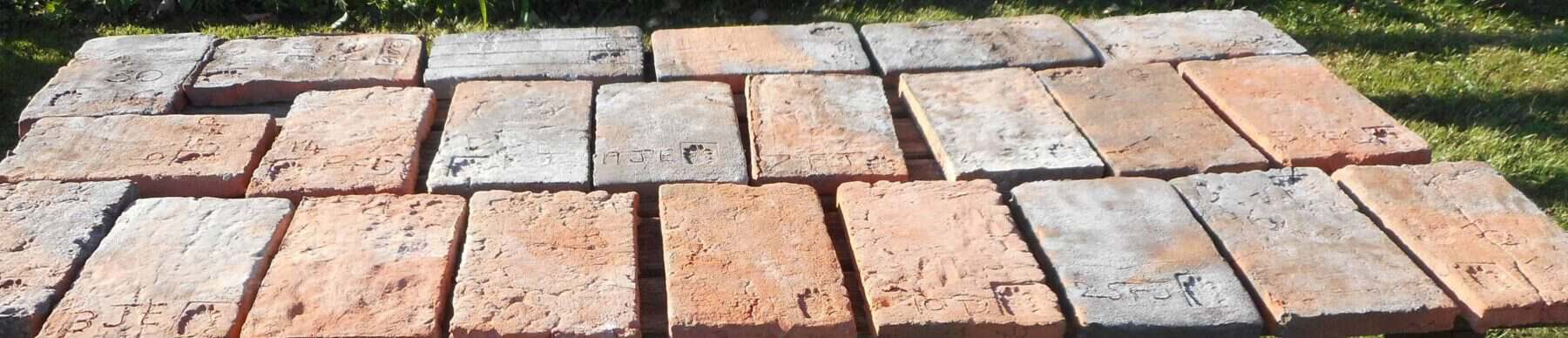
A feature of the walls of Stutfall Castle, and in fact most Roman forts, is a single or double row of tiles every five or six rows of dressed stone. The purpose appears to be threefold; as a levelling course, to make the wall more attractive and most importantly to bind the outer dressed stone to the rubble and lime mortar centre.
Again, the owners of the land agreed the kiln could be created there. A mini digger created the area for the kiln on the side of a slope to take advantage of the up wind. The clay from this excavation was placed on and covered by corrugated iron sheets to dry out. It was then crushed, the stones removed, re wetted and worked up into usable clay.
After a lot of debate about the size of the tiles, taking into account the shrinkage on drying and firing, several wooden frames were created.
The processed clay was pounded into the frames on a kiln sand covered base so they could be removed. A Boudica stamp was applied and the maker and date added. They were then laid on pallets and protected from the rain until they had dried out.
The kiln consisted of a fire pit above which was an iron grid. Onto this grid engineering bricks were used to build the kiln. The dried tiles were laid in herring bone fashion in the kiln with a pot and gull on top. The kiln was closed off with more bricks and the whole structure covered in clay insulation. It was then fired up and observed.
After allowing it to cool over a long period it was opened up to reveal that the iron grid had buckled under the heat and the tiles were in a heap. Fortunately, some 32 had survived which was sufficient for the project.
Building the plinth
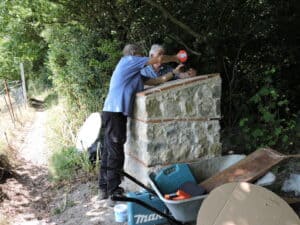
Permission was granted by the Aspinall Foundation to build the plinth on their land next to the path on the Saxon Shore Way directly above Stutfall Castle. A hole was excavated and a reinforced modern concrete base formed. Ragstone with one flat surface was gathered from various locations and construction began using the lime mortar and tiles we had produced. A time capsule was added in the middle of the rubble and the whole 1.2m structure was topped with tiles.
Onto the side was attached a plaque commemorating Maureen Lovering and Peter Stutchbury. On the top of the plinth a circular plaque of the Roman roads of Kent was added. The plinth was unveiled by Lord and Lady Howard of Lympne.