
Lympne’s Roman past
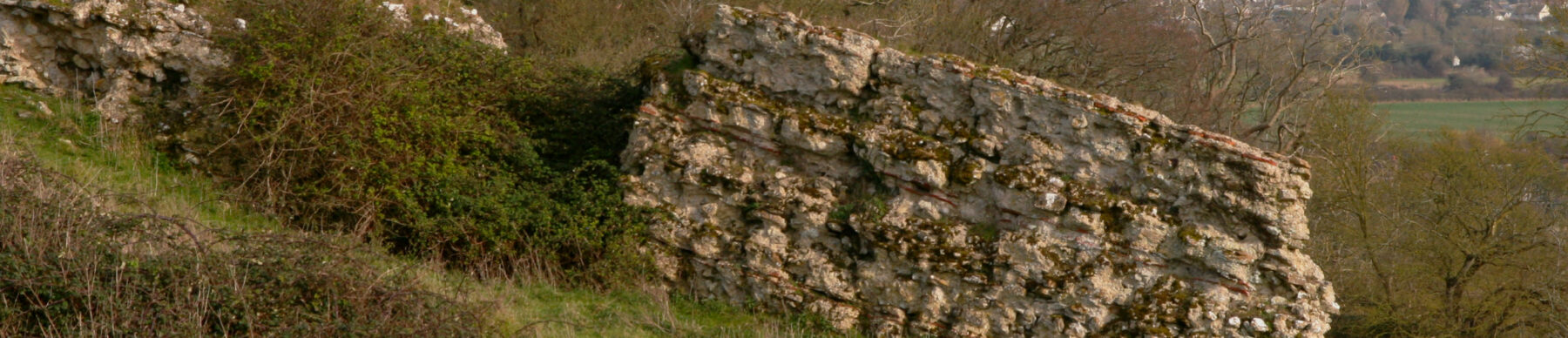
The ruined walls of Stutfall Castle, on the hillside below Lympne Castle, have been known as a Roman site for centuries. It is one of 13 late Roman ‘Saxon Shore’ forts built to defend the southern and eastern coasts of Britain during the third and early fourth centuries AD. Stutfall was extensively excavated in 1850 by Charles Roach Smith and again in 1978 by Barry Cunliffe. Little of the original shape exists due to land slippage and there is no visible evidence of the south wall. The final shape was only determined, as an irregular pentagon, in 1984 by J.N.Hutchinson who conducted a geological survey which discovered the original Roman timber piles.
SHAL became engaged with the local archaeology through the work of Malcolm Davies who spent many years, with SHAL support, looking for the Roman road to Stutfall and a possible earlier fort as well as the harbour it defended. In 2018 a small scale excavation on the site was incolclusive.
Malcolm introduced the group to Richard Taylor who assisted SHAL in covering some 16 hectares of farmland with magnetometry with the excellent co-operation of the farming families of the Owens and Hurleys. The results were astonishing and resulted in a community dig in 2022 that revealed, among other finds, a Roman cremation burial. In 2023 & 24 excavations revealed a previously unknown Roman structure, the nature of which is yet to be determined. Clearly Lympne, or Portus Lemanis as the Roman knew it, was a major defensive and trading location.
See Recent excavations for more on what has been discovered.