
Stutfall Castle
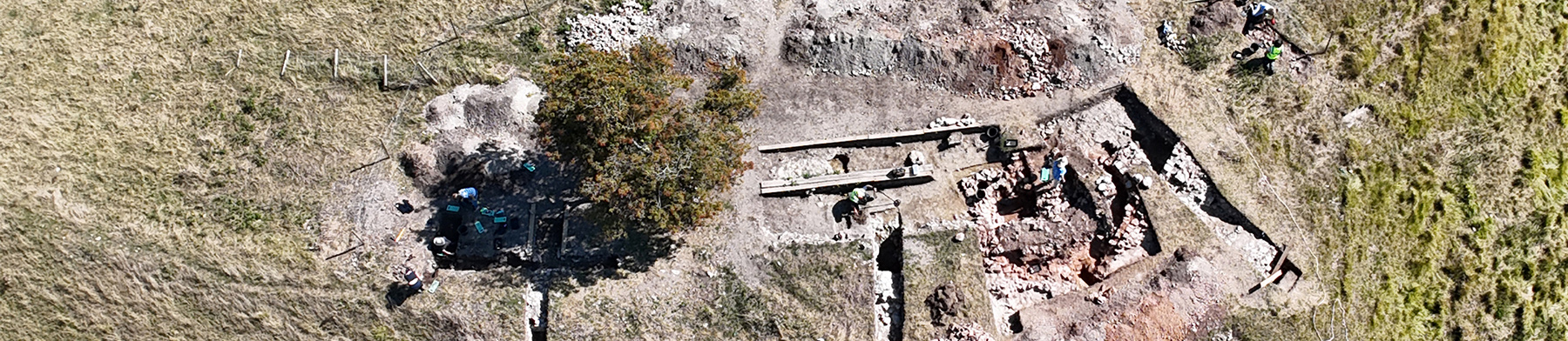
On 5–6 May 2018, members of SHAL excavated a small trench at Stutfall Fort, Lympne, Kent.
The fort is believed to have been constructed c.270 AD and the assumed coastline during Roman times would have allowed it to protect a natural harbour in an area now part of Romney Marsh. The remains of the fort were investigated by Charles Roach Smith in 1850 and more recently by Barry Cunliffe from 1976–78. In both cases, they discovered evidence from excavations to suggest that there was earlier occupation with military connotations. This was probably Classis Britannica, the Roman naval fleet, which commanded the waters between continental Europe and Britain.
Roach Smith found an altar stone – later dated to c.135 AD and dedicated to Neptune by Aufidius Pantera – reused in the foundations of the main east gate of the later fort, along with tiles stamped CLBR – the mark of Classis Britannica. Cunliffe also found an uninscribed altar stone in his re-excavation of the main east gate and describes the quantity of early Romano-British pottery found as “significant”.
Geophysical work carried out at the fort in 2015-16 produced evidence suggesting a previously unknown structure close to the main east gate. It seemed reasonable to investigate this possible structure for additional evidence of a second century AD occupation and Historic England and the landowner agreed to this. The objective was set for excavation to establish if the geophysical evidence was indeed a structure, and if it was a source of, or contemporary with, the Classis Britannica material discovered by Roach Smith and Cunliffe, thereby strengthening the case for an earlier phase of the fort’s Roman past.
Historic England granted site director, Malcolm Davies, license to excavate a five metre by one metre trench in an east-west direction aiming to uncover the probable western wall of the structure and possible internal and external areas. On 5 May members of SHAL began de-turfing the area and carefully divided the trench into ten equal compartments.
Over the next two days, members of SHAL, accompanied by members of the Shorne Woods Archaeological Group, carefully excavated the trench revealing some unexpected archaeology. While excavating within the parameters of Historic England’s instructions, the excavation did not reveal any conclusive evidence of earlier Roman occupation, but it did suggest the presence of a building of an unconfirmed date.